0%
of eligible prototype costs supported
Chapter I of four
Τα θεμέλια υπάρχουν ήδη The foundations already exist
Greece already holds the instruments: a live games incentive, a national rebate with a games line identified, the largest investment programme in its modern history, and a capital converting empty shops into places where companies begin. This chapter counts what is on the table.
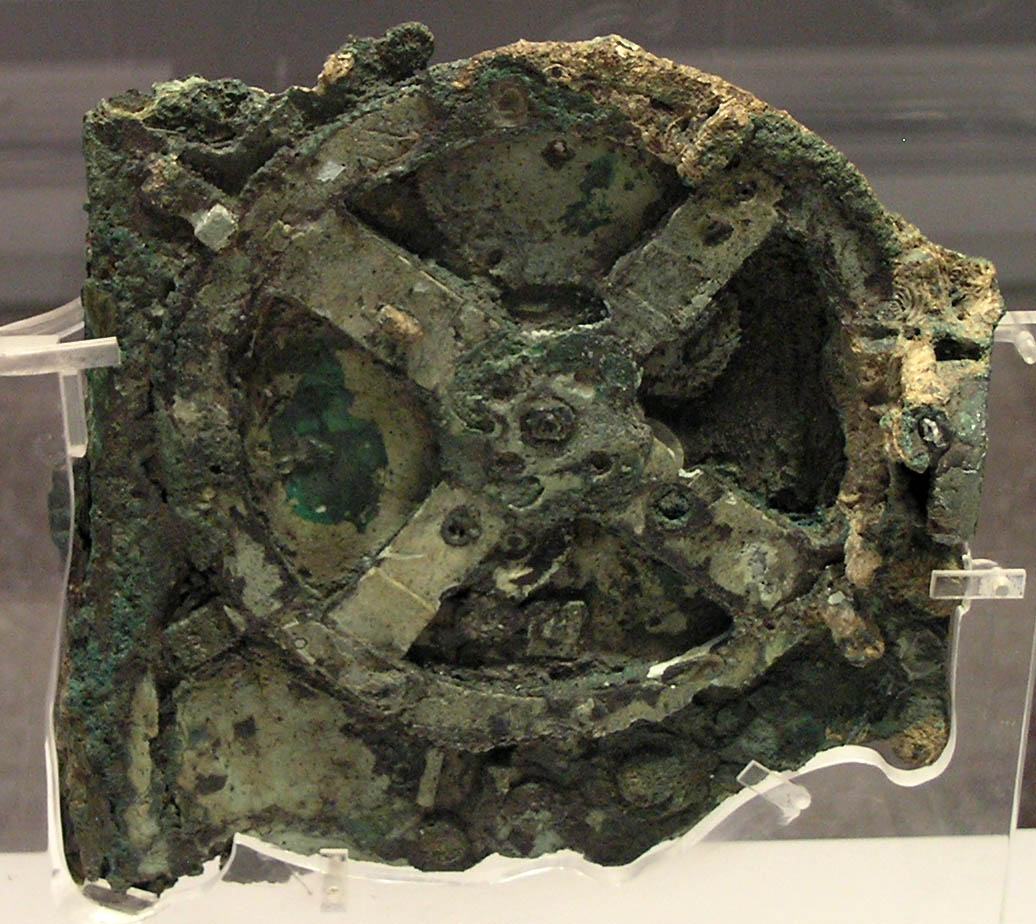
The Antikythera mechanism, c. 150 BC. National Archaeological Museum, Athens.
A machine of thirty bronze gears predicted eclipses two thousand years before the computer. Precision instruments are a Greek habit, and the instruments of a games policy already exist.
When the divers brought the Antikythera mechanism up from the seabed, nobody believed a device that precise could be that old. This chapter is an argument against the same disbelief. Everything below is in force, published, or formally identified today, every figure drawn from the official body that owns it. Read it the way a craftsman reads a workbench: not for what is missing, but for what the tools already there can build.
EKKOMED's CRGR-VGD scheme is a national games incentive with published mechanics and a funding logic that rewards finished games: the modest rate arrives at prototype, the serious rate arrives at completion. It is the structural core a larger programme scales from.
The 2026 Cash Rebate: one hundred million euros, and the line that matters
Total public expenditure €100m. The games allocation is identified, with activation expected through further announcement.
Every serious national games programme began as a line this size. The campaign's argument is not that two million euros is enough; it is that this is the line a country scales once the case is made, and the case is the rest of this site.
Rendered in Unreal Engine 5
Recovery and Resilience Plan, Greece 2.0: €36.61 billion, of which €18.22 billion in grants and €17.73 billion in loans, with more than a fifth committed to digital transition. It is the largest investment programme in modern Greek history, and games are a digital export industry that trains precisely the skills it names.
European Social Fund Plus adds over €5.3 billion for employment, skills upgrading and inclusive education across Greece. Games education, adult reskilling into games disciplines and studio apprenticeships are the kind of work this envelope exists to back, within the usual programme rules. A games industry is a ready-made instrument for both funds at once.
Through Attica 2021 to 2027, the Municipality of Athens supports new-business incubation in the vacant shops of the Commercial Triangle: a European capital converting empty ground floors into places where companies start. A games commons is the natural tenant for exactly that mechanism.
Greece hosts a EuroHPC AI Factory serving academia, research, the public sector and private enterprise, focused on health, culture and language, and sustainability. Games studios are heavy consumers of precisely this class of compute. The infrastructure map is filling in.
EKKOMED is bringing a national delegation to Gamescom 2026 alongside GDA Greece, IGDA Greece and Greek indie studios, the first outing of its kind: the Greek flag planted at the industry's largest gathering.
The Panathēnea 2026 gaming side event is being assembled by Arcweave, Couch Heroes, IGDA Greece, Iphi Games and Mythique Summit. The community is not waiting for permission to gather; it is building the room itself.
Every studio begins as a spreadsheet, and for the founder deciding where the next one opens, the Greek column is short.
The chapters around this one argue the national case. This section is for the other reader, the one with a spreadsheet open: the founder choosing where the next studio pays its salaries, and the investor asking why those salaries buy more here. Three sums, each resting on figures already cited on this site or named in the sources below.
The payroll line: ten salaries, one year
National all-sector average full-time salaries from one Eurostat series, 2024, times ten. Games salaries run higher everywhere, but the ratios hold.
Chapter II climbs the same ladder rung by rung, salary by salary. Here it is enough to see the whole of it at once: at the EU average, the same ten desks cost more than twice what they cost in Athens.
The incentive in force turns the arithmetic the other way. Take €500,000 of eligible completion-stage spend: at the published 30 per cent rate, €150,000 of it comes back. The scheme's own floor and ceiling frame the sum, €50,000 of minimum eligible Greek spend at one end and €1 million per work at the other, and the 2026 rebate carries a €2 million games line beside it. Eligibility, process and timing belong to the scheme itself, and a real application is work for qualified advisers rather than a campaign page; the point here is only that the mechanics are published and the arithmetic is short.
There is an honest objection to answer before the third sum: the games industry has just come through a bruising contraction, and between 2023 and 2025 studios closed and teams shrank across the established hubs. That cycle is exactly what favours a new entrant. Experienced people are available who were not available in 2021, distributed production matured under pressure, and the neighbourhood's leaders grew straight through the downturn. Counter-cyclical entry is how the last generation of hubs was built.
Which brings the arithmetic to its proof, one sea away. Turkey built the flywheel: studios that shipped, exits that returned capital, alumni who founded again. What Greece offers instead is the ground such a flywheel could stand on inside the Union: the eurozone under a studio's contracts, European intellectual property and consumer law over its games, and the single market on the buying side of every deal.
And the exits next door are not an abstraction. The buyers who fly to Istanbul can fly one hour further.
Greece's neighbours treat games funding as ordinary industrial policy. The United Kingdom runs prototype grants and has committed a dedicated boost across entry, emergent and expansion tracks; France returns thirty per cent of development costs through the CNC. These are the instruments the comparators consider normal, and Greece's own first line is already on the books. Scaling it is a policy choice, not an invention.
So the inventory closes where it began, at the workbench. Instruments in force, envelopes committed, rooms opening in the Commercial Triangle, a flag planted at Gamescom. What no workbench can supply is the hands, and the hands are the next chapter.
The tools are counted and the bench is set. Chapter II is about the hands that pick them up: the generation that left, and the routes that bring them home.
Figures verified against these sources on 8 July 2026. The founder's arithmetic figures were verified on 19 September 2026.